
The cerebral organoid enters its industrial era
Brain organoids are becoming industrialized, transforming drug discovery and neuroscience. Automation, 3D bioprinting, and regulatory changes are enabling scalable production, while large biological datasets are emerging as the key asset powering the next generation of AI-driven therapies.

Written in collaboration with Dr. Petra Szeszula (BrainZell) as part of the BrainTech Alliance.
As an investor specialized in BrainTech, we analyze several dozen companies every year developing technologies related to organoids, stem cells, and computational biology. This position offers a particular vantage point: that of technologies arriving on the market before they are widely documented. It is from this perspective that this text is written.
Sequencing a human genome cost 95 million dollars in 2001. Today it costs around 500 dollars. That price collapse brought genomics within reach of modest university labs and gave rise to an entire sector: consumer DNA tests, non-invasive prenatal diagnostics, custom gene therapies. A comparable mechanism, though less mature, is at work in the cerebral organoid space. Companies are positioning themselves on this segment across the world today, where five years ago only a handful of academic teams existed.
The artisanal lab
The cerebral organoid has existed as an object of research since 2013, when Madeline Lancaster and Jürgen Knoblich published in Nature the first protocol allowing human stem cells to self-organize into a three-dimensional structure reproducing certain features of cortical development, to the point of modeling microcephaly. The protocol was then a form of precision craftsmanship: manual embedding in a matrix, repeated pipetting, incubators monitored week after week, and a batch-to-batch variability rate that made two experiments difficult to compare between two labs, and sometimes between two technicians in the same lab.
This variability was for a long time the main obstacle to pharmaceutical use of the organoid, well beyond a simple technical detail. An academic lab can publish a result obtained on twelve hand-cultured organoids. An industrial player wanting to screen a thousand molecules against a disease model needs thousands of strictly comparable organoids, produced on the same date, with the same residual biological variance. As long as culture remained manual, this scale-up was out of reach, regardless of budget.
From sequencing to synthesis
The cerebral organoid begins with an upstream step: reprogramming human cells into induced pluripotent stem cells (iPSCs). For years, this process remained a bottleneck. Generating high-quality iPSC lines required skilled operators, weeks of manual work and substantial costs, making large-scale production difficult outside a handful of specialized laboratories.
Automation is beginning to change this equation. Robotic platforms increase throughput while reducing the variability introduced by manual handling, making iPSC production more reproducible and easier to scale. A similar transition is taking place one step downstream, where automated bioreactors and 3D bioprinting are progressively replacing manual culture and embedding, allowing thousands of organoids to be produced under more standardized conditions.
This does not mean that the biological challenges have disappeared. Batch effects, incomplete tissue maturation, limited vascularization and variability between iPSC lines remain well-documented limitations. Automation standardizes the manufacturing process, but it does not eliminate the intrinsic complexity of living tissue.
The important shift is therefore not that cerebral organoids have become a solved technology, but that they are becoming an industrial one. As genome sequencing transformed DNA reading from a specialized laboratory technique into routine infrastructure, automation is beginning to do the same for the production of human neural tissue. That transition creates the foundation on which an entire value chain can emerge.
A value chain taking shape
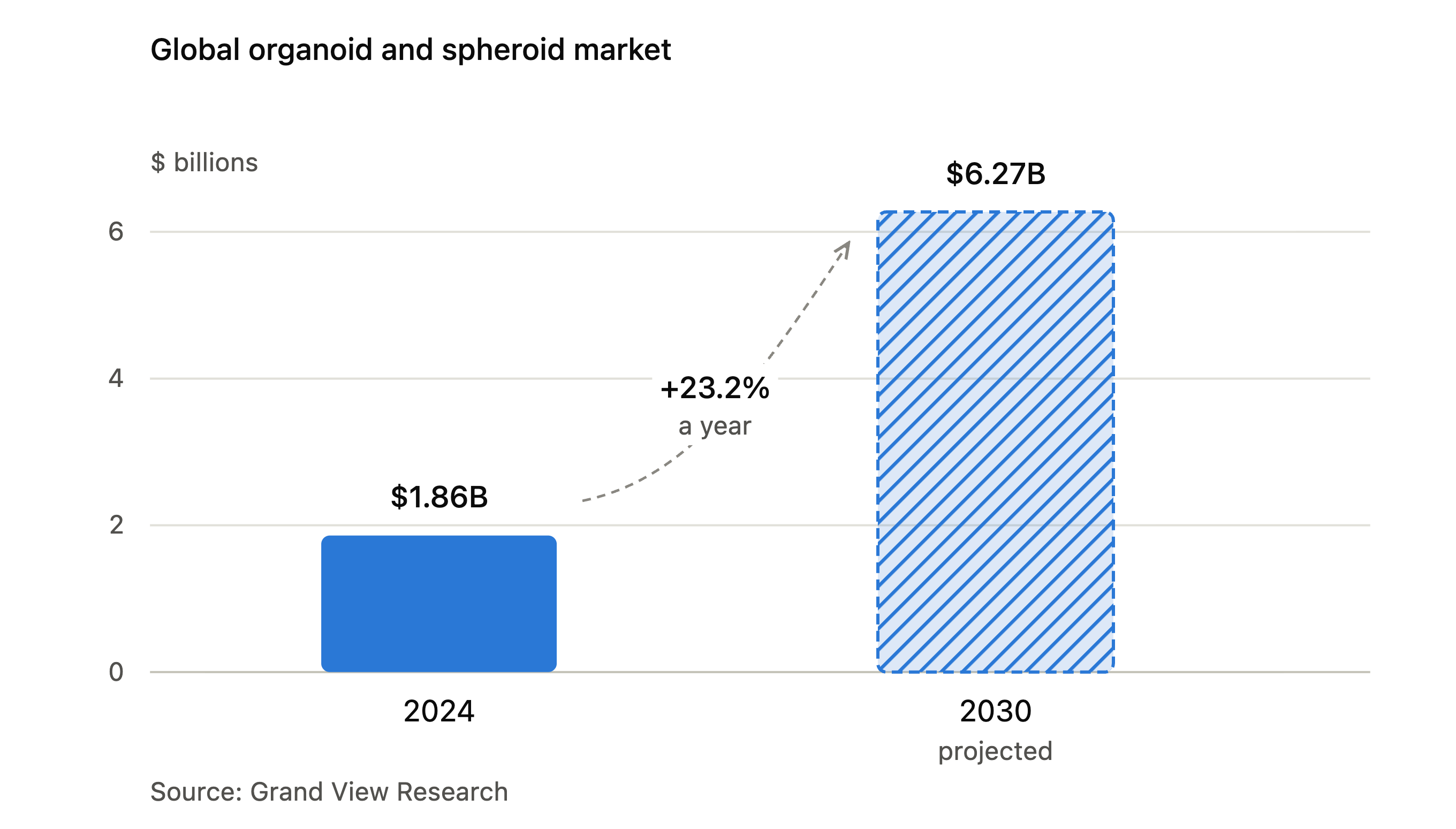
The companies emerging in this segment are spread along this chain, and the way they are distributed reflects the logic of a supply chain that is in the process of taking shape. Upstream, material suppliers such as Axolotl Biosciences, a spinout from the University of Victoria in British Columbia, produce specialized bio-inks for printing neural tissue. TissueLabs sells decellularized extracellular matrix hydrogels covering some fifteen tissue types, including neural tissue. These are the input suppliers of a sector that, five years ago, had to manufacture each of its own reagents.
Further downstream, platforms such as BrainZell industrialize high-throughput iPSC organoid production while incorporating an immune component, to identify therapeutic targets through computational modeling rather than manual screening. In Vienna, a:head bio made the opposite choice from a generalist platform: focusing a cerebral organoid model on a single disease, Dravet syndrome, a rare genetic epilepsy, to move quickly toward a precise clinical use rather than selling an all-purpose tool. Itay&Beyond, in Jerusalem, adds a readout layer: patient-derived organoids coupled to electrophysiological measurement and AI analysis, to predict a compound's efficacy. OrganoTherapeutics, in Luxembourg, takes yet another route, selling Parkinson's midbrain organoid work as a research service and accumulating the results in a disease knowledge graph.
These strategies coexist in the market, which is more a sign of a sector beginning to differentiate: a nascent sector generally produces only one type of player, a sector in the process of structuring produces several, positioned at different tiers.
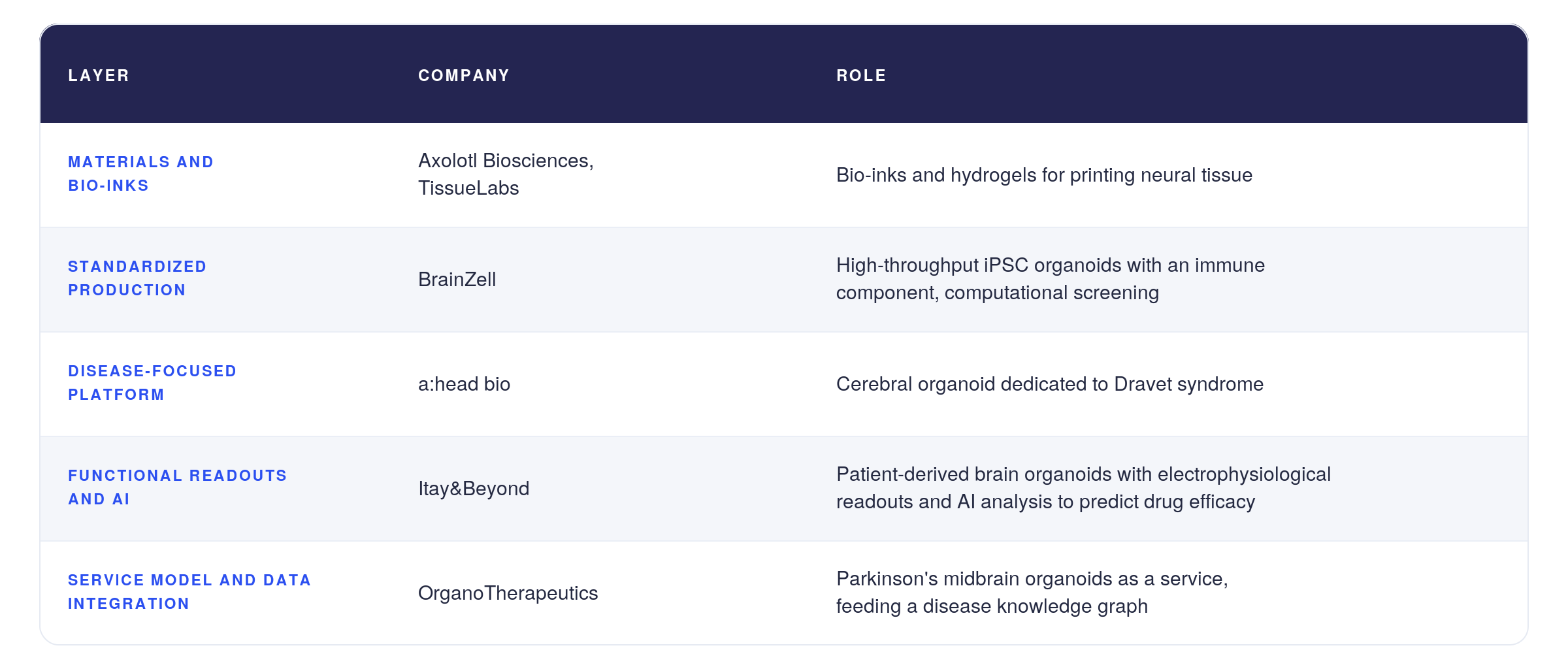
Capital is following this movement: according to Grand View Research, the organoid and spheroid market grew from 1.86 billion dollars in 2024 on a trajectory toward 6.27 billion in 2030, an annual growth rate of 23.2%. Sector platforms have raised cumulatively more than 2.1 billion dollars globally from their emergence through 2025. What amounted to a handful of academic teams five years ago now aligns roughly twenty identifiable commercial companies on the cerebral segment alone.
This count does not mean, however, that the value chain has stabilized. Some of these companies, like OrganoTherapeutics, have already positioned themselves on a service model (CRO) rather than a product model, others are pivoting toward it, and many still live mainly on non-recurring funding rather than regular commercial revenue. Some will never build a dataset rich enough to turn into an asset; others will be acquired before getting there; and the evolution of data-sharing standards between labs could, over time, erode part of the competitive advantage these companies are trying to build today. The number of identifiable players says something about the segment's appeal; it does not yet say which of them will sustain a standalone business model.
The regulatory lock loosens
Since the Federal Food, Drug, and Cosmetic Act of 1938, U.S. law required mandatory animal testing before any human clinical trial. That lock lasted 84 years.
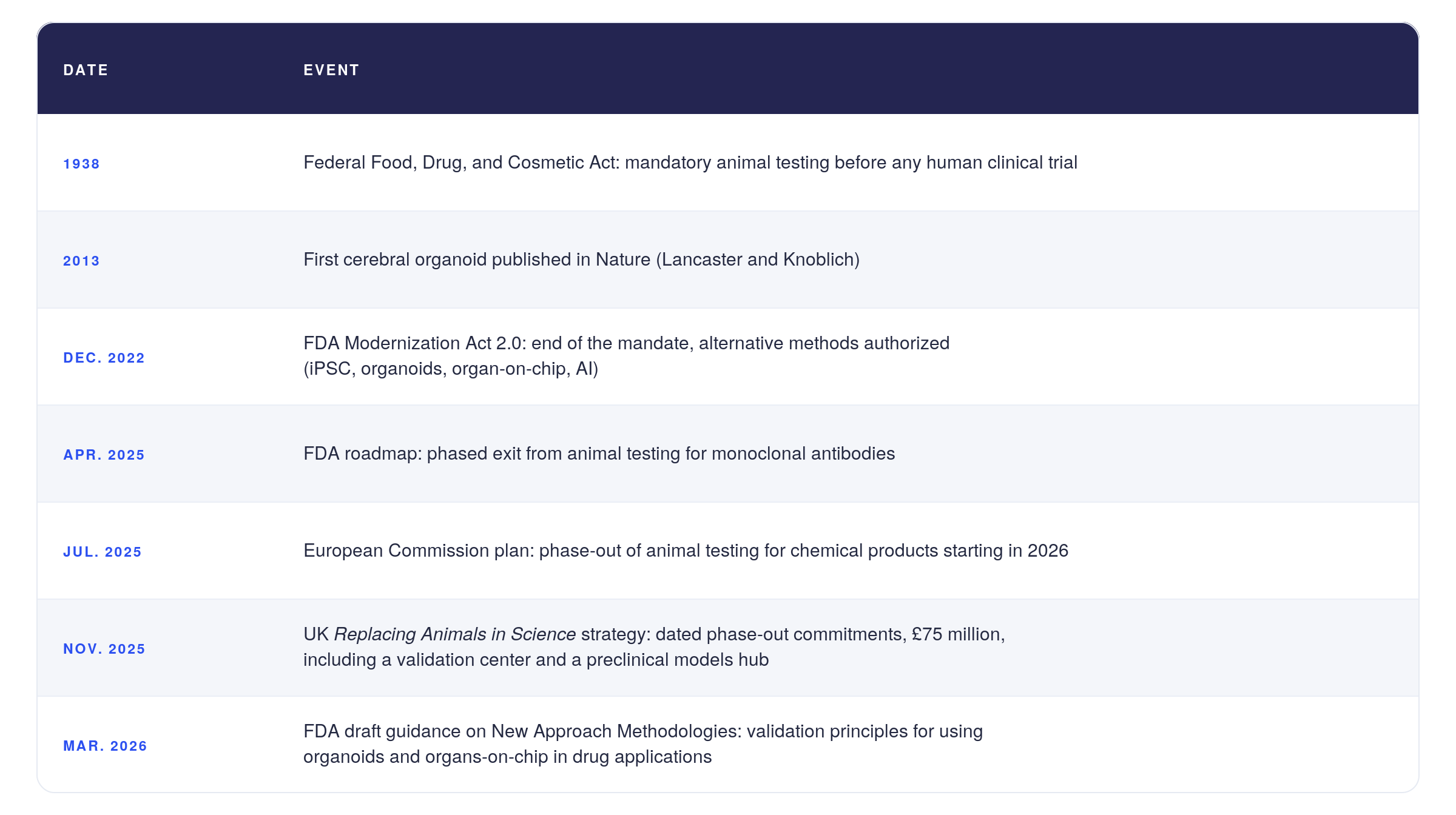
This regulatory loosening coincides in time with the falling cost of organoid production, without one being mechanically derivable from the other: the FDA did not change doctrine simply because producing an organoid became cheaper. Other factors play a role at least as important in this evolution: growing political pressure around animal welfare, the maturity of competing or complementary approaches such as organ-on-chip, advances in modeling and artificial intelligence, and the evolution of toxicological standards themselves.
What can be said more modestly is that industrialization makes this regulatory evolution more credible without explaining it on its own: a regulator only authorizes an alternative method if it produces reproducible results at the scale of an entire development program, which presupposes controlled batch variability and a production volume that industrialization facilitates, without guaranteeing it. The FDA’s March 2026 draft guidance now puts a name on that requirement: among the four core validation principles it sets out, technical characterization requires methods that are robust, reliable, and reproducible.
The cerebral organoid has had a scientific basis since 2013. What it lacked was a clear route to market, a recognized way of integrating into the healthcare system and getting reimbursed. That clarity is only now beginning to appear, as U.S., British, and European regulatory agencies open the door to these models as a recognized alternative, rather than one merely tolerated on an exploratory basis, to animal testing.
The raw material for AI
An organoid cultured under high-content imaging, analyzed cell by cell, and tested against a library of molecules produces a screening result, but also, as a byproduct, an image, a transcriptomic signature, a dose-response curve, and a culture history. Multiplied across thousands of standardized organoids, this collection becomes a training dataset. This is precisely the material computational biology has been seeking for a decade, and which it lacked as long as production remained artisanal.
The most advanced example comes from Recursion Pharmaceuticals, whose RxRx3 dataset gathers roughly 2.2 million cellular images covering 17,000 genetic knockouts and 1,674 molecules. Recursion runs its imaging campaigns at an industrial scale producing nearly 20 petabytes of data, on which the company trained Phenom-Beta, a foundation model that turns a microscopy image into a representation usable by machine learning, without prior manual annotation. It has since applied the same approach to the brain. Its Microglia Map, completed with Roche and Genentech in October 2025, gathers 46 million images of iPSC-derived microglia across some 100,000 CRISPR knockouts and thousands of compounds. Getting there required manufacturing over 100 billion microglia in a standardized way, precisely because these cells are notoriously variable from one batch to the next: the same industrialization problem, solved one cell type at a time rather than on a three-dimensional tissue.
In toxicology, some labs now run closed-loop systems that test concentration ranges on iPSC-derived organoids, capture terabytes of microscopy images per campaign, extract morphological signatures from them, and feed the result back into an algorithm that chooses the next dose to test, with reduced human intervention between iterations.
On the cerebral organoid specifically, and on openly available data, the gap remains wide open. The largest open, standardized dataset dedicated to the cerebral organoid currently counts 1,400 cross-lab images covering 64 individually traceable organoids. This is useful groundwork, and it is also a measure of the gap: four orders of magnitude separate this nascent dataset from the 20 petabytes already produced by systematic large-scale cell imaging. A biobank of 260 pancreatic tumor organoids, profiled with multi-omics, has separately made it possible to identify 2,794 molecular signatures associated with treatment sensitivity and 322 associated with radiotherapy sensitivity, for a single tissue type and a single indication. The brain, with its diversity of cell types, has not yet produced the equivalent.
Rethinking data collection so it becomes a genuine engine of innovation for brain diseases, rather than an accidental byproduct of research, is the question now on the table. Industrialization of the cerebral organoid offers a partial, mechanical answer, without fully resolving it: it produces disease models that are cheaper to manufacture, and, as a byproduct of every screening campaign, a more standardized type of data than in the past, even if residual biological variability still limits comparability across labs. And it gives access to something no cost curve elsewhere can supply: living human neural tissue that can be perturbed repeatedly. A solid tumor can be biopsied several times over the course of a treatment. The living brain essentially cannot. For most brain diseases, the organoid is not a cheaper model of human neural tissue so much as the only source available at scale, and the only one where the genotype can be chosen in advance.
The bet on data
This framing changes the question to ask about these emerging players. The first instinct is to look for whoever produces the cheapest or most biologically faithful organoid. That is a real question, but it is no longer the only one that matters over the medium term. As production industrializes across several players at once, what holds lasting value is no longer the culture vessel, which has become easier to reproduce than before, but the database it feeds: its size, its standardization across labs, and its ability to be linked to a real clinical endpoint rather than a simple in vitro marker.
This is a pattern comparable to what genomics went through. Cheap sequencing mainly created the raw material for UK Biobank, gnomAD, and the models trained on them, more than value in itself. The companies that captured the value were not necessarily those sequencing at the lowest cost, but those that built the largest database best connected to a clinical endpoint. For the cerebral organoid, that database does not yet exist at the scale it exists for individual cell types at Recursion. This is precisely the step from biomarker to product that remains to be written. An in vitro signal has to be tied to a recognized clinical endpoint, and that endpoint in turn to something measurable in a patient's daily life, before a healthcare system will reimburse anything built on it. We will discuss this further.
A market that is seeing its production cost fall and its regulatory environment loosen at the same time will probably not go long without a database to link the two. Whether that database is itself a business, though, is less clear. Selling access to one has not yet demonstrated durable revenue anywhere in the sector, which suggests the data may turn out to be an input rather than a product.
If that is right, at least two other routes deserve attention. One is to turn the platform inward and develop drugs on it, where the potential revenue is larger by an order of magnitude, and the risk with it. Another is the companion diagnostic: an organoid-derived signal recognized by a regulator, prescribed alongside a treatment, and reimbursed on that basis. No such test exists today, and the path would be long, but it is the mechanism through which a laboratory readout has historically become reimbursable. Hybrid arrangements may well be the norm for some years, a service business funding a pipeline while the data accumulates.
We do not know which of these will hold. What seems worth asking of each player identified today is which one it is building toward, and whether it has the balance sheet to get there.