Belgium: The small country quietly redefining European innovation
Belgium is emerging as a key European innovation hub. With growing VC activity, a strong HealthTech and biotech ecosystem, and a healthcare system built for digital innovation, the country offers fertile ground for globally minded founders.

1. A Venture Ecosystem moving against the European tide
Across Europe, the last two years have felt like a long breath held: fewer deals, shrinking rounds, cautious investors. Belgium, however, has been writing a very different story. While most ecosystems contracted, it expanded. Venture funding has grown by 37% since 2022, reaching €4.45 billion. The country’s share of European VC has more than doubled, climbing from 3.2% to 7.8% and ranking 10th, just behind France and Germany, in VC invested per capita. On the ground, this translates into a dense and collaborative ecosystem, with about 9 startups per 100,000 inhabitants and four unicorns, including Collibra and Odoo.
This momentum is first and foremost a Flanders story. The region captures over half of all startup capital invested in Belgium and has been above the EU average in VC per capita since 2023. Ghent, Leuven and Antwerp combine dense founder communities with top universities (Ghent University, KU Leuven and the University of Antwerp), which together have generated 340+ spin-outs and place Flanders among Europe’s leading regions for university-derived value.
In Brussels, the gravitational pull of EU institutions and global companies nourishes a multicultural startup scene. Meanwhile, Wallonia has entered a phase of reinvention, with VIVES preparing a fourth fund of up to €250 million, one of the largest university-backed seed funds in Europe, and regional players like Wallonie Entreprendre, Noshaq and Invest.BW building a foundation for long-term growth.
Together, these regions don’t form a fragmented ecosystem, they form a lattice. Belgium’s innovation trajectory is not linear but interconnected, and that may be its greatest strength.
2. Why HealthTech is emerging faster here than elsewhere
Belgium’s healthcare system offers something relatively rare in Europe: coherence. Many countries talk about interoperability; Belgium has gone further in making it function in daily life. The national MaSanté platform and federal eHealth infrastructure allow patient information to follow the individual across providers, an experience many European citizens might expect to be standard but often is not.
Hospitals collaborate in networks rather than silos, while healthcare financing is organised through competing mutualities rather than a single central payer, creating a more decentralised but flexible environment for experimentation. This combination creates a care environment that feels notably smooth to patients and highly workable for innovators. It also underpins Belgium’s approach to digital health. Through the mHealthBelgium framework, launched in 2019, medical applications follow a path from certification to market access with limited financial support. While reimbursement levels remain modest, this framework reflects an exploratory but concrete effort to anchor digital tools in routine care.
In recent conversations, Belgian patients described being able to schedule an MRI scan at unconventional hours, because scanners operate nearly continuously, and they do not need to repeat their medical history each time they switch providers, while mutualities guide them through a system that feels structured rather than overwhelming.
For founders, this matters. A system that is efficient and interconnected offers faster access to early data, smoother clinical workflows and higher expectations for digital coordination. Belgium is not merely open to HealthTech; it is increasingly ready for it.
For founders, this matters. A system that is efficient and deeply interconnected lowers the barrier to clinical experimentation. Because hospitals are connected through shared IT systems and networks, founders can access early data, test solutions and validate them in real care settings, while also enabling commercial scaling.
Add to this the country’s longstanding biotech expertise, embodied by global players like GSK, UCB and Janssen, and Belgium becomes one of the more credible European environments for evidence-driven digital health.
3. A Global Mindset From Day One
Belgian startups rarely stay focused on their domestic market for long. With a small internal market and multiple languages, they develop from the outset in an environment that already resembles international scale. They learn early to navigate cross-border reimbursement models, multilingual product development and complex regulatory architectures.
This global mindset from day one aligns naturally with Newfund’s Road to the USA approach. Belgian founders are used to thinking beyond borders; what they often need is the right partners to accelerate.
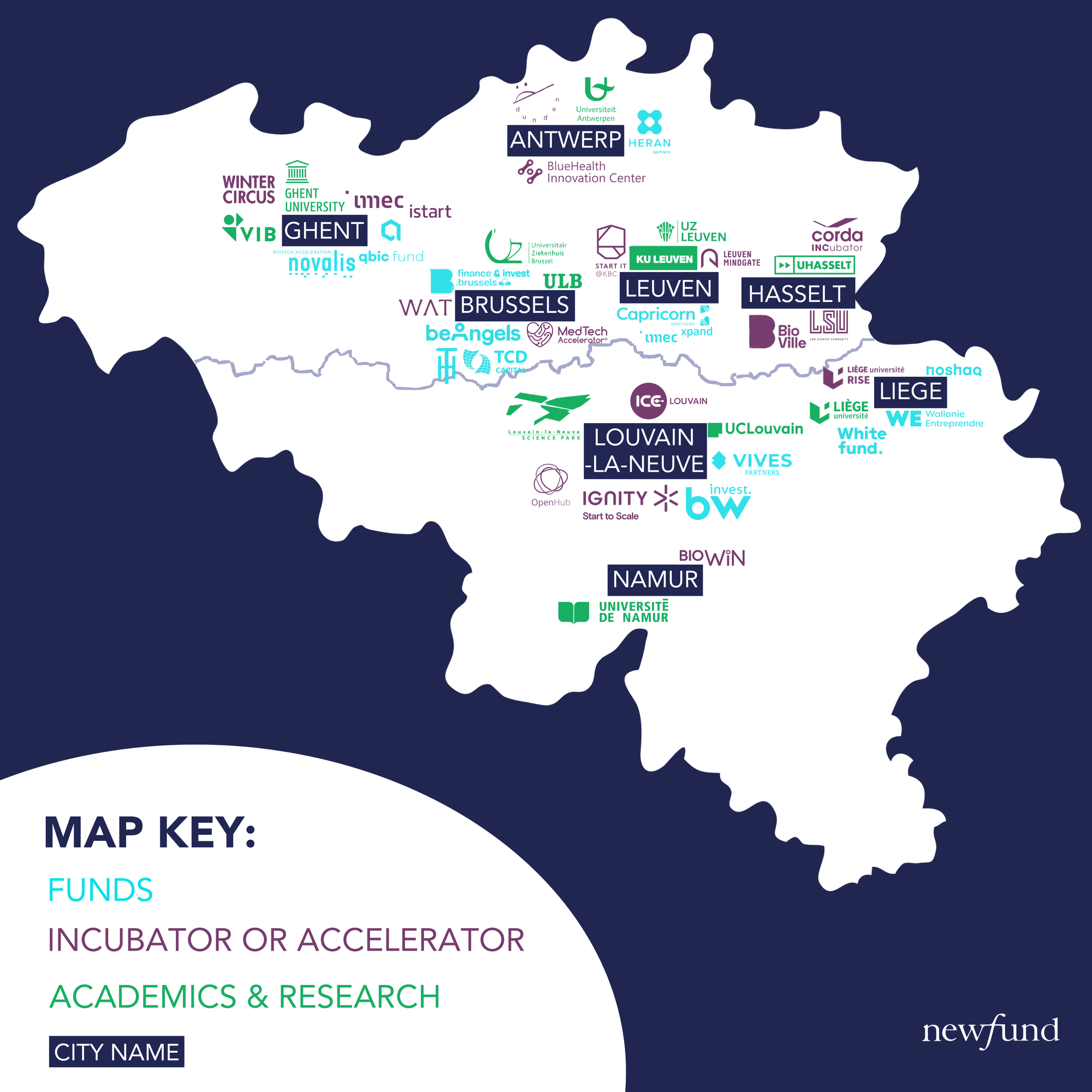
As Belgium enters this new chapter, more ambitious and more outward-looking, we are seeking to collaborate with regional investors, hospitals and universities to help build the next generation of Belgian HealthTech leaders. Below, we share a mapping of some of the most active actors in this growing ecosystem, with a focus on MedTech and digital health.
The mapping can be seen below in a visual format, and also in a tabular form by clicking on this link.